
From today, people in the UK can purchase a specific solar panel, take it home, plug it into their socket and enjoy free renewable electricity. No need for expensive installers or electricians, just a trip to a local supermarket. Director of Innovation & Net Zero, Balazs Csuvar weighs up the risks and implications for social landlords and sets out some practical government guidelines to prepare for next summer.
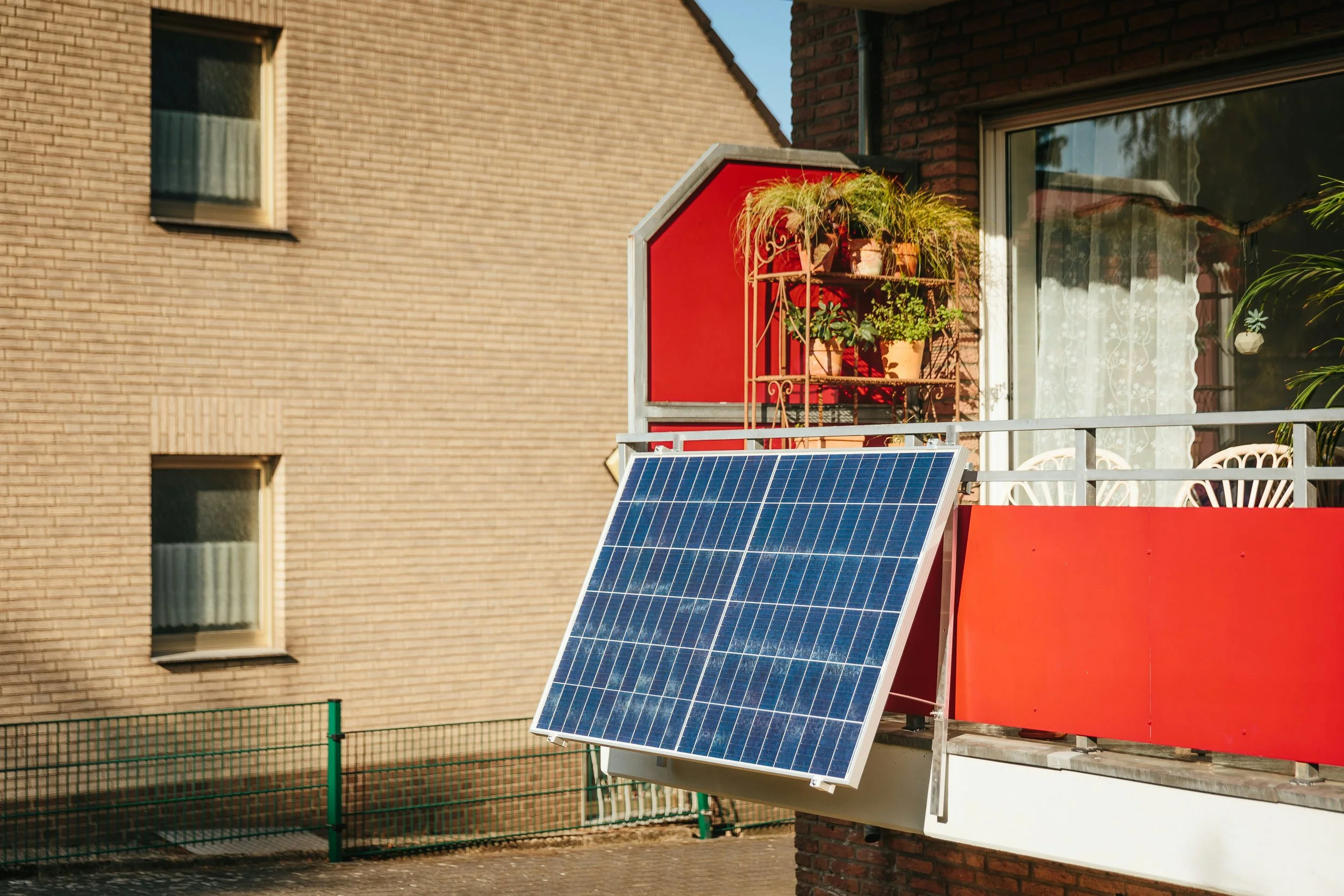
Unsplash/Yuma ’balcony solar’ in Germany
Often referred to as ‘balcony solar’, these systems typically consist of one or two solar panels and a microinverter that plugs directly into an ordinary wall socket. For renters and flat-dwellers previously excluded from the solar transition, this represents a significant step forward in democratising renewable energy.
However, moving from concept to widespread UK adoption requires more than just updating product safety standards. At DG Cities, our experience working alongside local authorities and housing providers highlights a critical gap in the current policy discussion: the specific operational, safety and governance challenges faced by social housing providers.
The DG Cities’ perspective: balancing opportunity with risk
Over 10 million people in the UK live in social housing as tenants or leaseholders. For these households, many of whom face acute cost-of-living pressures, the ability to lower monthly energy bills through plug-in solar is a hugely welcome prospect.
Yet, social housing providers find themselves in a challenging position. While eager to support net zero goals and alleviate tenant fuel poverty, landlords carry strict statutory obligations regarding building safety, fire risk and asset management. Without proactive government guidance and clear regulatory frameworks, the unmanaged rollout of plug-in solar could create severe compliance headaches and safety risks.
What are the operational and technical challenges?
Outdated electrical infrastructure: Social housing stock across the UK varies dramatically in age and condition. Many properties feature older electrical wiring and consumer units that may not safely accommodate additional back-fed generation without risk of circuit overload. The German example highlighted by Craig Morris, Director of the German association for balcony solar is that outdoor sockets are essential for safe installs. This is not a practice in the UK. Many social housing tenants, particularly those who have lived in a property for a short time, would likely not be aware of these hidden technical limitations.
Unsafe or improper DIY installation: While the Interim Product Specification sets strict engineering controls for manufacturers, it cannot guarantee safe end-user installation. Risks include overloading individual circuits, using unsuitable extension leads or mounting panels insecurely on high-rise balconies and exterior walls.
Ambiguity in enforcement vs. enablement: Social housing providers currently lack clarity around their legal powers and regulatory responsibilities. If a tenant installs an unapproved or unsafe kit, landlords are left uncertain as to how to enforce safety rules without resorting to punitive measures that harm tenant relations.
Lack of funding: While the system will only cost £100s, financial returns usually take a number of years. It is unclear people have the right finance available to access these, especially those who could most use the savings. Social landlords could therefore set up financial structures to help tenants with the installs.
What does the sector need to do before next summer?
To ensure plug-in solar delivers on its promise without compromising resident safety, DG Cities calls on the government to couple its regulatory announcement with a dedicated support package for the social housing sector. What might this look like?
1. Point-of-sale safeguards
Address registration. Collecting the installation address at the point of purchase would help enforce limits on the number of microinverters per household circuit and signal to consumers that installations are trackable. It could also form a database to notify social housing providers about a likely deployment on their estate.
2. Operational guidance

Workforce upskilling: Housing providers need standardised training modules for their in-house electricians and maintenance teams to inspect plug-in solar setups, identify risky practices and verify circuit safety.
Tenant toolkits: Landlords need clear, accessible guidance materials to distribute to residents, outlining suitable mounting locations, circuit limits and step-by-step safety checks.
3. Policy and proactive delivery
Clear regulatory powers: The government must provide explicit guidance defining the legal rights, responsibilities, and enforcement mechanisms available to social landlords regarding unapproved installations.
Landlord-led scaling models: Rather than viewing plug-in solar purely as a reactive enforcement issue, providers should be supported to lead the rollout. Guidance should cover the way councils and housing associations procure, co-finance or bulk-install standardised balcony solar systems safely across whole estates, maximising cost savings for tenants while retaining full control over installation quality.
It’s an exciting advance, but caution is still required
Plug-in solar represents a genuine breakthrough for urban energy democratisation.
However, in our experience, treating it solely as a consumer hardware update misses the complex reality of managing multi-occupancy, public housing stock. By providing social housing providers with clear statutory powers, operational guidance and workforce training alongside the PSSR regulatory changes, the government can ensure that this technology lowers bills and carbon emissions without compromising building safety.
