
After many years of testing and trialling, 2026 is set to be the year automated vehicles become commercially operational on UK roads. On social media and on the streets of London, automated vehicles are here for all to see - and soon will be open to real paying customers. Ed Houghton, Balazs Csuvar and Lara Suraci explain how the team’s research for the Department for Transport brought insights from a series of public workshops into the development of safety principles.
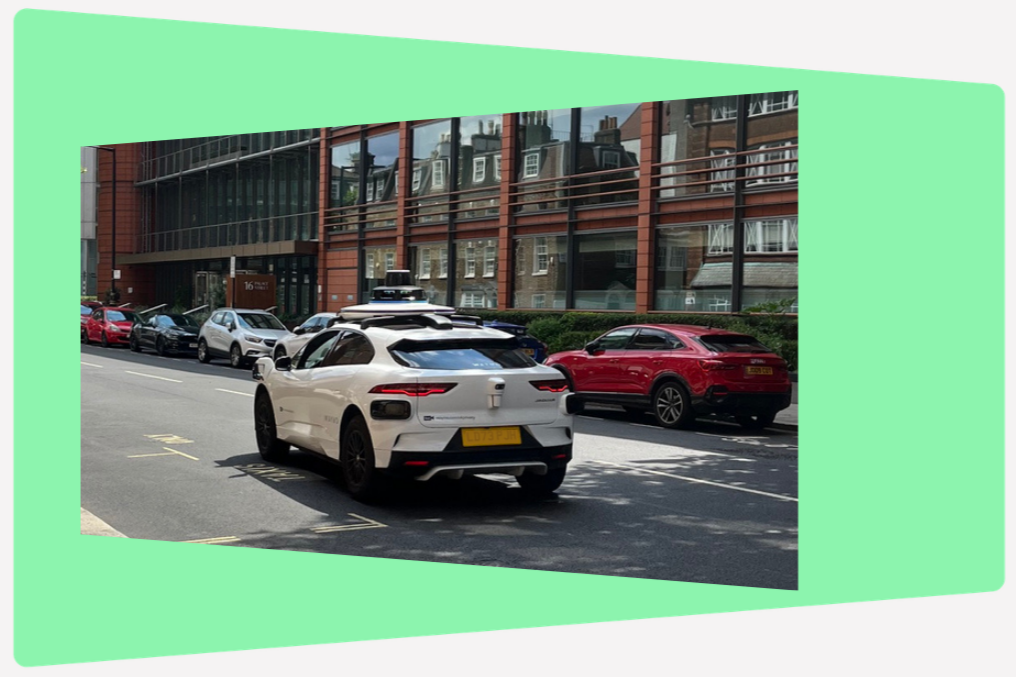
Over many years, we’ve explored public attitudes to automated vehicles, from the first trial in the UK, through to live testing on Greenwich roads. We’re pleased to see the technology develop to a stage where commercial operations could become a reality.
But over the course of our work, we’ve become keenly aware of the complex attitudes of the public towards AI and automation in mobility. Using an automated vehicle isn’t as simple as asking an AI chatbot a question, or searching Google for an answer. Safety, and the perceptions of unsafe mobility and lack of control, play a major part in the intention to use automated vehicles. To enable adoption it is critical the public trusts automated vehicle operators and believes them to be safe.
This is why we were pleased to work with the Department for Transport this year to explore the standards of safety that the public expects, and through deliberative workshops, undertake a deep investigation into what drives expectations, and how safety standards need to be conceptualised against existing safety standards on UK roads.
Exploring safety through deliberation
During the winter of 2025/26, DG Cities undertook an important piece of deliberative research to ascertain what the public think of the previously established safety ambition of having AVs be as safe as careful and competent human drivers. It is the benchmark for automated driving safety as defined in the Automated Vehicle Act 2024.
We delivered six workshops across three areas in the country (rural, semi-urban and urban), gathering diverse opinions through a format that ensured people gained a deep understanding of the topic and had time to reconsider and shape their initial stance.
Based on our research and a prior formal consultation largely commented on by industry, the DfT team has established 10 safety principles that automated vehicles will need to adhere to in the UK. We wanted to review how the public views established through our research have helped define these 10 principles:
1. “Self-driving vehicles should use the road in accordance with traffic laws and the Highway Code.”
The Research Link: Participants found the phrase ‘careful and competent’ ambiguous, it needs to be expanded on through a more direct link with concrete and measurable performance expectations. The public specifically cited "compliance with traffic rules" as a basic, objective behavioral measure of a safe driver. It is worth noting, however, that participants also highlighted the need to continuously review and update the Highway Code to reflect changes in driving environments and adapt to new challenges.
2. “Self-driving vehicles should maintain control over the vehicle at all times.”
The Research Link: Participants applied a very high standard to AVs, expecting them to avoid even many incidents that a human might struggle with. This principle addresses the public’s expectation of smooth, stable driving and "maintaining awareness of surroundings" during unexpected, rapidly changing events.
3. “Self-driving vehicles should predict, detect and respond to hazards proactively.”
The Research Link: When describing a careful and competent driver, the public explicitly focused on the ability to ‘anticipate hazards’ better than a human driver can due to superior technological capabilities. At the same time, participants frequently referred to human qualities such as ‘common sense’ and ‘intuition’ that translate into a vehicle's ability to predict the behaviour of others and take proactive action, rather than merely reacting at the last second.
4. “Self-driving vehicles should adapt their driving to road and weather conditions.”
The Research Link: The research highlighted that context was shown to play an important role. Specifically, participants from rural environments heavily emphasised speed management, limited visibility and adapting to road conditions as the primary indicators of a competent driver, directly resulting in this principle.
5. “Self-driving vehicles should behave in a predictable manner.”
The Research Link: A recurring theme in the workshops was the need for transparency and traceability in AV decision-making. Research participants wanted to understand what the AV is doing and why, both as passengers as well as other road users - particularly drivers who we spoke to. By mandating that AVs communicate their intentions clearly, humans are enabled to better understand an AVs actions and therefore may feel safer as passengers.
6. “Self-driving vehicles should improve road safety in Great Britain for all.”
The Research Link: The research revealed that most participants had a limited grasp of actual casualty statistics, but intuitively expected AVs to minimise risk and manage foreseeable hazards appropriately to a standard higher than the average driver. This principle translates that general public expectation into a mandate that AVs must demonstrably improve overall safety and without disproportionately shifting risk to any one group. Some of our previous research that tested this concept specifically also found that support for AVs increases significantly when overall road safety improves.
7. “Self-driving vehicles should interact safely with all road users, particularly vulnerable road users.”
The Research Link: While rural participants focused on road conditions, the research noted that urban participants focused more on interactions with pedestrians and other road users. Half of our research group was specifically non-drivers, all of whom expressed concerns for their safety and the need for AVs to consider vulnerable road users specifically.
8. “Self-driving vehicles should interact safely with emergency services.”
The Research Link: Our research participants expected AVs to handle complex driving situations seamlessly. Encounters with emergency vehicles require deviations from standard driving rules (like pulling over or navigating around an active scene), reflecting the demand that AVs possess a level of situational "intuition" and responsiveness to authorised officials. Whilst emergency vehicle scenarios were not specifically included in the research questions, it is a principle that aligns well with the concepts discussed during deliberation.
9. “Self-driving vehicles should only operate autonomously within the limits under which they are specifically designed to function.”
The Research Link: Because the public acknowledged that context dictates safety, the research explicitly concluded that the findings support the regulatory approach of defining AV capabilities in terms of ODDs (Operational Design Domains). This principle reassures the public that AVs will instantly recognise their own limits and won't attempt to drive in environments they aren't capable of handling safely. Research participants found the concept of ODDs intuitive and logical, similar to how they might make decisions about driving or not, in case of icy conditions as an example.
10. Self-driving vehicles should be designed to take account of the specificities of the territory where they will operate.
The Research Link: The public explicitly distrusted sweeping safety claims from AV manufacturers, noting that AVs must prove their safety locally. The research found that participants wanted "real-world safety outcomes data" and comparisons that actually reflect the environments they live in. This principle mandates that training data and safety comparisons must be representative of this country’s locations and drivers, rather than relying solely on international test data. Previous foreign experience was still deemed as an important benchmark factor, but not a replacement for local demonstration of capabilities.
Reading through the safety principles, it also becomes clear that the ‘careful and competent’ driver term is no longer used as the benchmark for AV safety. This acknowledges our research, as participants frequently criticised the term as ambiguous and lacking enough specificity for a safety metric. We also found that people often had difficulty defining what makes a human driver careful and competent, as all drivers can be careful and competent, they might just not act as such. Careful and competent driving is a behaviour that needs to be exhibited continuously, rather than a fixed state.
Instead, ‘careful and competent’ looks to have been developed into a more precise term: “sufficiently representative of GB drivers who are unimpaired, not distracted and follow traffic rules” which we believe more accurately reflects what participants expect from safe AVs

The value of a deliberative approach
Road safety is a matter for all communities, and the adoption of automated vehicles is designed to look to improve road safety. However defining what is safe, and for whom, is not something which can be done by policy makers alone. Engagement with the public is vital, and as this research shows, the voice of the public has the power to shape and influence how innovative technologies play a part in all of our lives.