
This week, we’re excited to launch findings from our research into how behavioural systems mapping can bring new understanding and solutions to address digital exclusion in older adults - a project we delivered with five local authorities in collaboration with University College London. Director of Research & Insights, Ed Houghton explains the difference solutions can make when thinking shifts to ‘cause’ from ‘effect’ and takes into account the wider neighbourhood.

Understanding what drives digital inclusion is a challenge for many across the public, private and third sectors. The digital divide is changing, but not for the better – whilst more people are connecting to and making use of the internet, those that are excluded are becoming even more so. This deepening of the divide, which acts to exacerbate the negative impacts of digital exclusion, is only going to get worse with ubiquitous technology that continues to evolve. Taking active steps to lessen the digital divide must become a priority.
Many organisations across the country are working hard to reduce the impact of digital exclusion; helping people gain access to the internet, become confident and capable in how to use it and supporting them to safely navigate it. From Digital Champions programmes that use a peer-to-peer model of learning, through to excellent device lending and re-use schemes, there is a lot happening to help people.
But a major challenge many programmes face is that often they focus on the “effect” end of digital exclusion – the person needing support. While this is vital, and can generate tangible benefits for individuals, it doesn’t necessarily change the “cause” side of the equation. The pressure to change is instead on the individual to flex and accommodate digital services or tools, learn new skills and shift their habits and beliefs to make use of services.
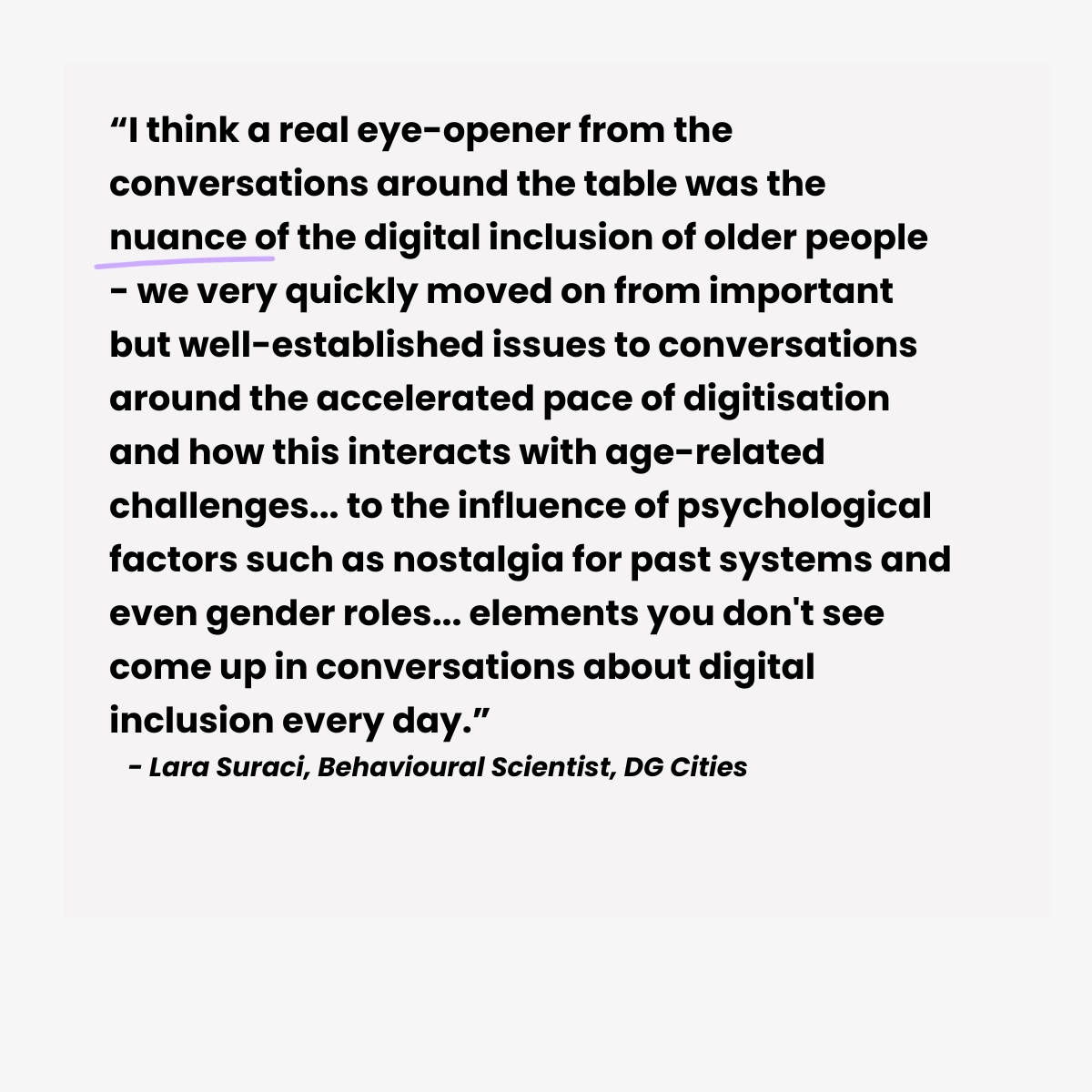
It is for this reason that we undertook research as part of the UK Government’s Digital Inclusion Innovation Fund to trial a new method, Behavioural Systems Mapping, to help unpick the systemic factors that are driving individual digital exclusion. Our aim was to see whether or not it is possible to reorient the focus of our thinking; to move from ‘effect’ to ‘cause’, to change the system so that it better accommodates and supports those most vulnerable in our society.
Our focus was on supporting older people, exploring neighbourhood dynamics that influence the digital exclusion of people aged 60+. This week we’ve published the findings of our research, and a new guide to help public sector and third sector professionals to explore the method and apply it to their own work.
Seven months, five local authorities
Over the course of seven months, we worked in five neighbourhoods across the country to trial Behavioural Systems Mapping with local authorities and their third sector and NHS partners. With our consortium partners the Royal Borough of Greenwich, Ealing Council, Haringey Council, Leicester City Council and North East Lincolnshire Council we ran four workshops, a mix of online and face-to-face sessions to develop maps from the ground up – defining actors, their behaviours and the drivers shaping them.

Using this map we then identified leverage points – the places where changing the system is likely to create impact – and worked with each neighbourhood to develop intervention blueprints that describe the policies, processes and activities that could be implemented.
Throughout the project we tracked important lessons from the process to understand the feasibility of Behavioural Systems Mapping, and the value it brings to local government teams. We wanted to assess not only if the interventions were well aligned to the neighbourhoods (e.g. not off-the-shelf, but designed for their context), but also what could be done to improve mapping and the outcomes of the process. We then used these lessons – like ensuring user engagement throughout, and making sure not to overly complicate the map by being more focused, to develop our guidance for the public sector.
So, what did the study reveal?
Firstly, Behavioural Systems Mapping is an effective diagnostic and design tool for addressing neighbourhood-level digital inclusion among adults aged 60+. There were added benefits to it too, particularly in bringing stakeholders together around the same table (virtual or otherwise) to share their perspectives and explore the system they work in together. Secondly, by uncovering systemic drivers, the mapping process revealed that local digital inclusion issues are in fact grounded in distinct behavioural systems. Thirdly, when backed by expert facilitation and mixed-methods data, each neighbourhood managed to generate targeted interventions ideas.
However, the methodology does have limitations: resulting maps were highly complex and required time to embed and navigate. Also, because these maps primarily reflect stakeholder perspectives, direct community engagement is essential to validate underlying behavioural assumptions and stress-test the resulting interventions. Engagement became a vital part of the method, which in the future we would ensure is embedded throughout.
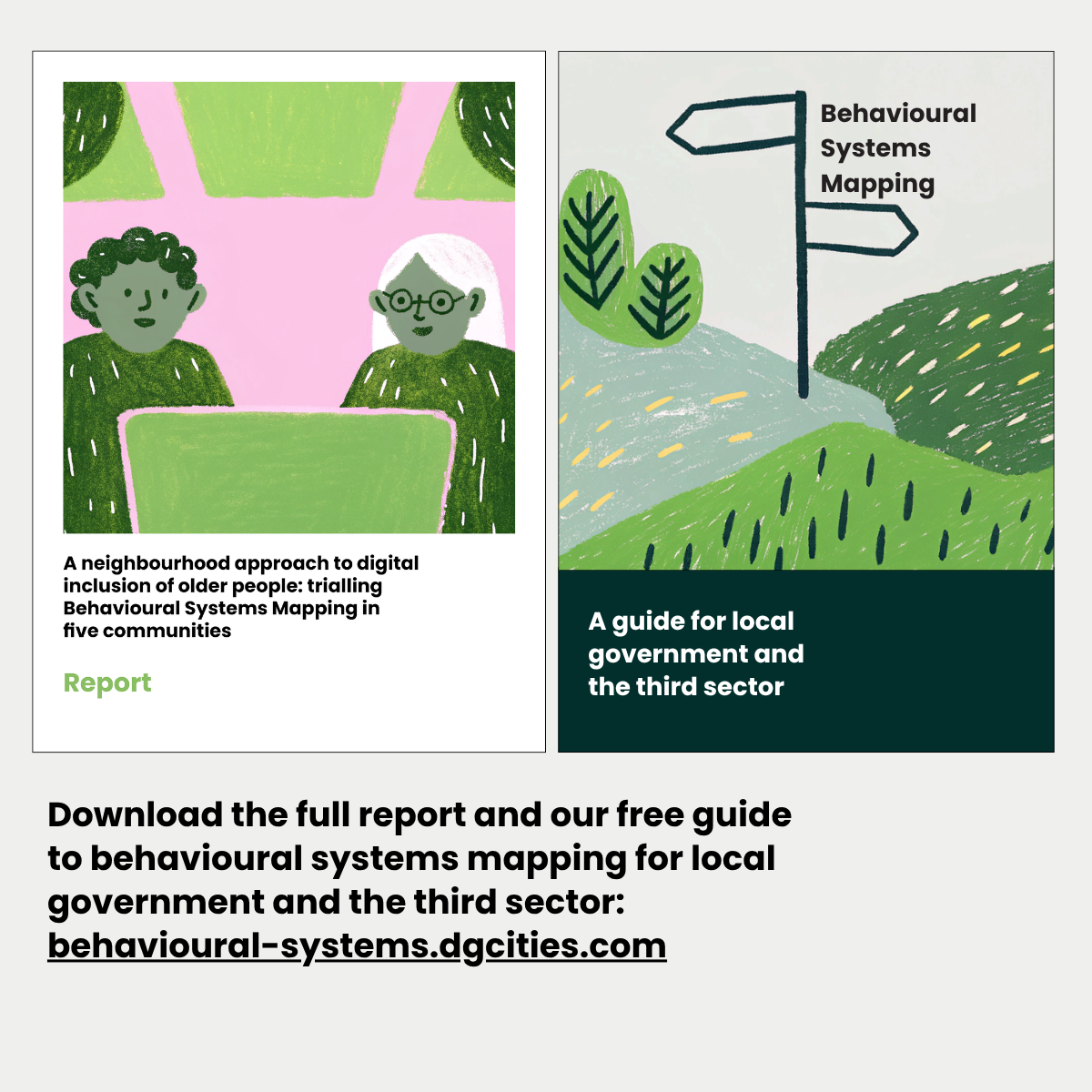
We’ve captured the findings in an easy to explore website, where you can also download the reports and guidance.
We think there’s a lot of potential in Behavioural Systems Mapping as a method for a variety of issues and we’re excited to see what others do with this in their work. It is truly participatory and provides a valuable step-by-step approach to reveal hidden or undescribed factors that shape digital exclusion. The resulting outputs are the result of deep collaboration and shared understanding of complex systems and we think that thinking and acting with this in mind is the way to unlock digital inclusion for those most vulnerable in our communities.