
As public services increasingly adopt digital-first services, it’s becoming impossible to separate digital inclusion from equitable healthcare access. Behavioural Scientist, Lara Suraci explores how Behavioural Systems Mapping (BSM), a collaborative method we have been using to map behaviours and their drivers within a complex system, could offer ways to bridge these two areas.
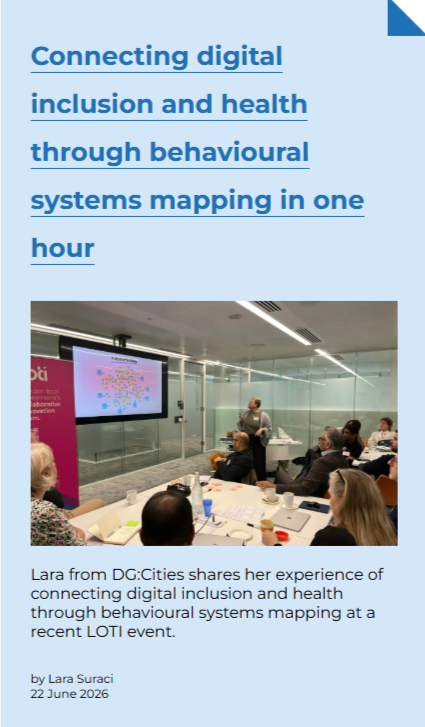
Initially developed by DG Cities to address broader digital infrastructure challenges, BSM consistently revealed how intertwined health literacy and digital exclusion have become. To test the versatility of this framework, LOTI conducted an experimental, high-speed one-hour BSM workshop at their Digital Inclusion Symposium. Bringing together a diverse group of healthcare professionals, service designers, and community representatives, the session tackled a specific health crisis: annual flu vaccine uptake among digitally excluded older adults.
Even within the tight timeframe, the exercise successfully captured 32 behaviours and 22 drivers, shedding light on the immense value of offline social infrastructure, such as trusted community figures and informal family networks. It illustrates BSM as a live, strategic tool. As the NHS shifts care from hospitals into communities, BSM provides local government and healthcare providers with a way to visualise system-wide complexities, moving past oversimplified narratives of ‘hard-to-reach’ groups to design interventions that make healthcare engagement possible, easy, and beneficial for everyone.
Read more over on LOTI’s blog.