
What started as a capital investment prioritisation tool for the Royal Borough of Greenwich has become a cross-cutting intelligence platform, now being applied to damp and mould response, regeneration, retrofit and stock condition surveys. Here’s Net Zero & Innovation Consultant, Rasheed Sokunbi on what we’ve learned so far.
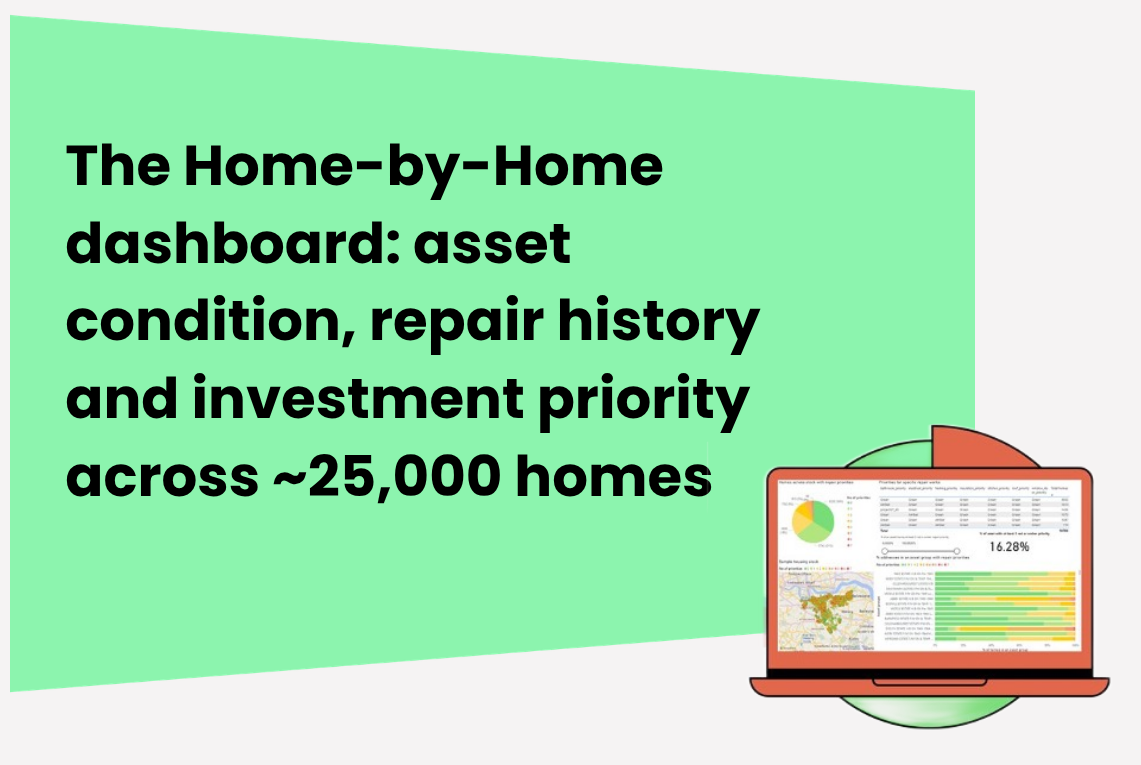
When it comes to housing asset management, every social landlord has the data. There’s information out there on responsive repairs, planned programmes, EPC certificates, compliance and more. The problem is that this lives in silos, ages quickly and rarely informs investment decisions when it matters.
The Home-by-Home Plan set out to change that by bringing it all together into a single, property-level view of condition, risk and need, turning it into a prioritised, evidence-led capital programme.

Case study: the Royal Borough of Greenwich
We have been working closely with the Royal Borough of Greenwich to apply the Home-by-Home Plan and make it even more useful to the housing teams. What began as a capital investment tool has now expanded into many distinct programmes, building on the original plan:
Capital investment prioritisation: RAG (Red, Amber, Green Prioritisation) system used to rank every home, estate and asset group based on need and repair spend across the entire portfolio. Helped the team to determine where capital spend should go.
Damp and mould sensor allocation: Cross-referencing repair history and disrepair data to target IoT sensor deployment to the highest risk homes first.
Regeneration appraisal: Identifying stock where repair spend and remaining asset life make continued investment harder to justify.
Retrofit and net zero prioritisation: Scoring homes by EPC rating, fabric condition, repair history and renewable dates of common retrofit assets (windows, doors, insulation) to create a sequenced, fundable retrofit pipeline.
Stock condition survey allocation: Mapping where survey data is missing or outdated to prioritise future survey commissions and close data gaps.
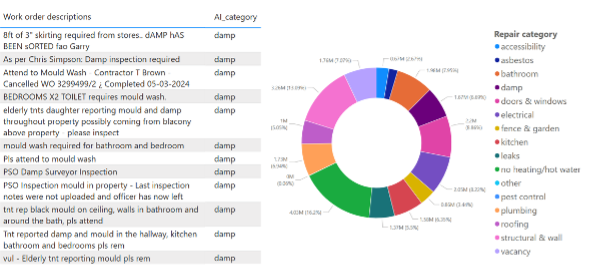
AI (LLM) was used to help categorise over a million rows of reactive work order history
What issues are other landlords coming to us with?
The conversations we have been having with housing associations and councils tend to start in the same places: data that exists but has never been joined up; Awaab’s Law pressure with no proactive targeting methodology; retrofit commitments with no delivery pipeline; regeneration decisions that lack an evidence base. The advantage of the Home-by-Home Plan is that it does not require perfect data to start delivering value. Instead, it is designed to work with what you have, surface the gaps, and build a picture that gets sharper over time. The model can also be used to evaluate current capital programmes o ensure that funds are being spent in the right areas.
““The Home-by-Home Plan has fundamentally changed how we have conversations about investment. We no longer walk into a programme meeting relying on gut feel or whoever surveyed last. The data is there, it’s consistent, and it gives the whole team confidence that we’re spending in the right places.””
What are we learning?
As the tool has been refined and applied, we’ve gained a deeper understanding of some of the issues housing teams are facing and how we can help. For example, in delivering more holistic insights. The data is almost always there, but sometimes it’s fragmented. Repairs systems, survey records, compliance logs, stock condition data: every housing provider has more than they think. The challenge is joining it up, not finding it.
Another hard part of the process is trust. Getting housing teams to act on data rather than instinct takes time. Getting a working view in front of officers quickly matters more than waiting for perfect data quality.
We’ve also learnt that different providers sometimes have different priorities. The model has to be flexible enough to surface what matters most to each organisation, whether that is compliance, building an asset management strategy or retrofit programmes.
Then there is the regulatory context. The Regulator of Social Housing’s own judgements make the scale of this problem hard to ignore. Of all C3 and C4 providers 88% had data cited as an issue. The most common specific problems were stock condition data and data quality and accuracy more broadly. In practice these are almost always the same issue: not knowing the true condition of the housing stock. The Home-by-Home Plan exists precisely to close that gap.